Showing posts with label bird art. Show all posts

Saturday, August 22, 2020

Audubon and the bird art of America

 For many years I was somewhat ambivalent in my opinion about the bird drawings of John James Audubon. And it is difficult to pinpoint exactly when and why this changed. Perhaps the tide turned during a chance conversation in 2018 about Audubon's art when it was pointed out to me that ...'this is ART!'

Indeed this is 'Art', not just bird art.

Some would argue (as I once did) that many of Audubon's birds are stylized and are not natural looking. That the pose is contrived. Would you actually see a heron in the wild as drawn above by Audubon? Maybe not. But that is one reason that this is 'art'.

For many of us the gold standard of bird illustrations are the lithographs of John Gould. Audubon's drawings are very different from Gould's. With Audubon you quite often get the charismatic virtuosity of Paganini's caprices for the violin, compared to the soothing lyricism of Chopin's preludes for the piano as with Gould. And just as it is with a piece of music, once you've listened to it a few times and have begun to understand what the artist is striving for, so it has been for me with Audubon's bird drawings. 

The onomatopoeic Chuck-will's-widows are animated with excitement in the presence of a snake. Pedants point out that the snake has been incorrectly named by Audubon. But what is undeniable is the vitality of the drawing.

A Louisiana heron preens itself at the edge of a swamp. The vegetation appears to have been ravaged by a storm in the not-too-distant past.

A pair of curlews probes for crustaceans and mollusks with their impossibly-long bills. Just as the inhabitants of the city in the background would have searched for their fortunes in those exciting times in America?

So who was Audubon and what was his story? 

To tell us something of Audubon we must turn to his biographer and foremost scholar- Richard Rhodes. His 'John James Audubon: The Making of an American' is an award-winning biography. And in Rhodes' introduction to a selection of Audubon's writings in 'The Audubon Reader'  we have this succinct primer to Audubon:

'(Audubon)... explored the American wilderness from Galveston Bay to Newfoundland, hunted with Shawnees and Osages, rafted the Ohio and the Mississippi, identified, studied and drew almost five hundred species of American birds, saw English noblemen kneel before him to examine his dazzling drawings, raised the equivalent of  several million dollars to publish a great work of art, wrote five volumes of "bird biographies" larded with narratives of pioneer life, won fame enough to dine with presidents and become a national icon, "The American Woodsman", his ultimate appellation, a name he gave himself.'

This 'great work of art' is, of course, 'The Birds of America'. Initially drawn over the course of five years from 1820 to 1825, it was first published in 1827. Audubon continued to add drawings of new birds to the book over the next ten years or so.

Audubon wanted to illustrate his birds almost life-size. He chose to make the drawings in double- elephant folio, each engraved and hand-coloured plate sized about two-by-three-foot. 

Using this folio size would still present obvious problems: how do you fit a drawing of a very large bird, such as a flamingo, or a crane, or even a heron, onto a 2x3 ft. sheet? And still manage to make these illustrations comparable to those of tiny birds, such as hummingbirds?


This is how such paintings compare on the actual plates. Not unsurprisingly, the flamingo's neck has to be swung right down to the toes to fit the plate (but that is how they feed, don't they?). The hummingbirds have the run of the sheet - full freedom and space to hover easily over nectar-filled blossoms.

In an earlier post about another classic bird artist Edward Lear, we had seen that he drew most of his birds from captive specimens in zoos.

http://jaipurbirding.blogspot.com/2020/07/edward-lear-bird-artist-extraordinaire.html 

Not so Audubon.

Audubon observed at first-hand, in the wild, what he drew. With shotgun in hand he explored large swathes of frontier-expanding America in search of his specimens. Any unfamiliar-looking bird was shot and examined minutely. This may sound unsettling to some readers today, but in most cases it was a necessity from his point of view. Obviously in the early 1820's there were no sophisticated cameras with telephoto lenses. Many of the birds themselves had never been identified or described by science. 

By 1826 Audubon was ready with his first tranche of water-colours of American birds. He traveled to England to find an engraver and to start displaying his drawings. Much like the modern day musician, who must perform in front of live audiences to earn from his creative output, he rented halls to display his works- with all the bells and whistles! Yes, literally so, since potential subscribers also needed to be entertained with impersonations of bird calls and with war cries of tomahawk-bearing hard-riding braves. 

Over the years Audubon would make several expeditions to different parts of America to add new bird specimens to his collection of drawings. His adventures in the newly-opened frontiers of America make for interesting reading. His writings are evocative of the landscape, of the many perils of the journeys, and of the excitement of the chase. These 'bird biographies' were published as accompaniments to the bird drawings. The bird observations are accurate and detailed enough to for him to be called an ornithologist.

There is also a sense of poignancy as we look at some of the drawings today. For instance, Audubon observed Passenger pigeons in the 'millions'. Modern estimates put their numbers in America at that time at 3 billion! Fully one-third the numbers of all American bird species put together. Now there isn't even one.


A clearly enamored pair of Passenger pigeons. This painting reminds us of the multitudes that Audubon describes in his writings- not unlike the vast herds of buffalo that once grazed the plains of America back then.

Here is an extract from Audubon's essay on the Passenger pigeons:
'I cannot describe to you the extreme beauty of their aerial evolutions when a Hawk chanced to press upon the rear of the flock. At once, like a torrent, and with a noise like thunder, they rushed into a compact mass, pressing upon each other towards the center. In these almost solid masses they darted forward in undulating and angular lines, descended and swept close over the earth with inconceivable velocity, mounted perpendicularly so as to resemble a vast column and, when high, were seen wheeling and twisting within their continued lines, which then resembled the coils of a serpent.'


Ivory-billed woodpeckers. Also extinct now. 

Here are some more of Audubon's paintings...

A Roseate spoonbill. I'm reminded of a pair of bellows with the spout shaped like a spatula!

Black-bellied Darter
Glossy Ibis

Next up in this series of blog posts we will take a look at the bird art of John Gould.

Sahdev Singh
August 2020

Wednesday, July 15, 2020

The bird art of Edward Lear

 Ennui, brought on by the lock-down, has been mitigated for many of us by the simple joys of reading . In my case, by re-reading some books about bird art and artists.Two of the great bird artists from the 19th century were, of course, John Gould and John James Audubon. Their timeless illustrations have delighted many who appreciate birds and bird art.

But this particular post is not about either Gould or Audubon. Rather, it is about Edward Lear.

Edward Lear? 

If the name does sound familiar to most people, it's because people remember him for his nonsense verse. For his limericks. Those familiar with his art probably appreciate his landscape paintings. Indeed, the success of his professional career is measured by his considerable achievements as a landscape artist.

However, for some of us Lear is best remembered for his bird illustrations.

A Common Crane. Poised, with understated elegance. For sure one of Peter Matthiessen's 'Birds of Heaven'.
 
To truly appreciate Lear's bird art, you have to place it in context: not just that it is almost 200 years old, but also that he was one of the first to use the new process of lithography. A technique which he quickly mastered.

But for me, Lear is special because he drew his sketches (which were developed later into his masterpieces) from live specimens of birds in European zoos and private menageries. He would not have had the luxury of seeing many of these birds in their natural habitat.

Yet, the discerning eye will certainly note that his illustrations have an extraordinary 'true-to-life' quality. A naturalness, a ring of authenticity. From observations of captive specimens he was able to project in his drawings how the birds would actually appear and behave if you were to see them today in their wild surroundings.

His technique - of placing the finely delineated bird upfront in the observer's face while muting the background in monochrome or subtle shades - has often been copied but never surpassed.

Lear cut his teeth in the art world with his very own production of lithographs of parrots.
Also parakeets, lories, lorikeets, cockatoos and macaws- for his original aim was to cover all the birds of the parrot family from all over the world.


A macaw. Perched, as if with a conspiratorial air, on the shoulder of a pirate.


A pair of parakeets. Plumed and crested, with blushing cheeks.

Disappointingly, after starting in 1830, Lear had to abandon his parrot series within a couple of years. He published just 42 plates.
Even though the illustrations were critically acclaimed in London, with many aristocrats subscribing to his publications, the project was not a commercial success, mainly because some of his subscribers failed to pay.

For the next few years Lear's life was inextricably linked with that of John Gould. Employed by Gould, he illustrated many of the standout plates for some of Gould's masterful series of publications: The Birds of Europe, Birds of Asia, Birds of Australia, among others. 
 
Here are some of these illustrations by Lear-

A pair of Ospreys. With rather disgruntled expressions, like those of anglers contemplating their private lake where poachers have cleaned out all the fish overnight...


Or a large solemn-looking owl with faintly unfocused eyes. Drawn thus perhaps because  Lear understood that the round facial discs funnel and amplify sound to the ears? Many owls are hunters more by sound than by sight.


Dalmatian Pelicans. Also familiar to us in the Indian subcontinent. Beautifully drawn with that untidy tuft of feathers on the back of the head and nape (an identification feature that a birder would appreciate). 


A Greylag Goose. Always elegant in flight or in the water, but here animated on land too, with its distinctive web-footed waddle.


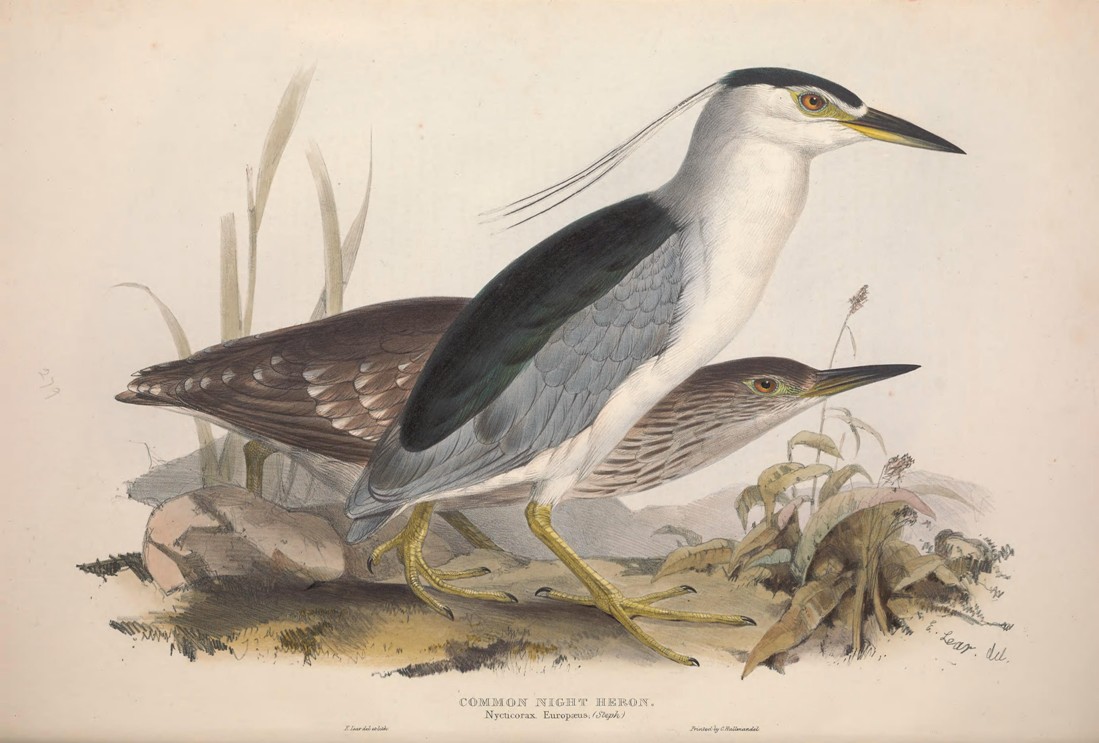
A pair of night herons stealthily navigating through the waterside vegetation.


Purple herons are widely distributed across Europe, Asia and Africa. 

Lear also illustrated some of the toucans and trogons that Gould produced as separate series of lithographs.
Again, the plates that Lear drew have their own distinctive stamp. Of animation and liveliness. The toucans, for instance, with their enormous bills, and bright-eyed piercing gazes...


One of the books now open in front of me, 'Edward Lear - A Life of Art and Nonsense' by Jenny Uglow, is a sheer delight. Almost every page is peppered with Lear's poetry and limericks and sketches and the text is enlivened by the author's obvious enthusiasm in sharing Lear's life with the reader. 

In 1837 Edward Lear would begin his travels in Europe in search of his calling as a landscape artist. His journeys over the next few decades would take him from Europe to the Levant, to Africa and even to India.

His travels are recorded for posterity in the form of daily journals: the written observations are often hilarious, and the text is accompanied by rapid-fire sketches and drawings of the people, the landscapes, the birds and the animals.

 Vidya Dehejia's 'Impossible Picturesqueness: Edward Lear's Indian Watercolours, 1873-1875' brings to life his Indian journal and the hundreds of drawings that he swiftly dashed off as he traveled across the country in fourteen months. He was now in his early sixties, and this would be the last of his major expeditions outside of Europe.


Kanchenjunga from Darjeeling. The chorten beside the path, the ferns and creeper-festooned  trees frame the Kanchenjunga massif in the distance.

 Lear would continue to write and to draw the characters that inhabit his verse and to publish his 'books of nonsense' which delight us to this day. In this particular genre he is right up there with Lewis Carroll.


The sharp-nosed portly gentleman is a self-caricature of Lear himself...

Lear himself can close this post with an extract from one of his poems:

Herons and Gulls, and Cormorants black,
Cranes, and Flamingoes with scarlet back,
Plovers and Storks, and Geese in clouds,
Swans and Dilberry Ducks in crowds.
Thousands of Birds in wondrous flight!


Sahdev Singh
Jaipur
July 2020