Showing posts with label Jaipur birding. Show all posts

Monday, December 12, 2011

Birding at the jheels around Jaipur

Chandloi jheel, near Jaipur, has been chock-full of ducks, geese and waders again this winter. We have made a few trips out in late November and early December 2011, and the birding has been excellent. Here are a few images from these trips ...


Ruddy Shelduck alighting on the shore ( Woolly-necked Storks in the background)


Three Common Shelduck made it back this winter. Five birds were observed in January 2011. These are rare migrants to our parts ..


Another winter visitor - the Brown Shrike ...


Long-tailed Shrike ...


A pair of Ospreys has returned again ....


Green Sandpiper ...


Spotted Redshank ..


Booted Eagle - the white 'headlights' on the shoulders showing clearly ...


Wood Sandpiper ...


Streaked Weaver, male. Was lucky to observe a group of Streaked Weavers in the tall grasses ringing the embankment ...


Yellow Wagtail ..


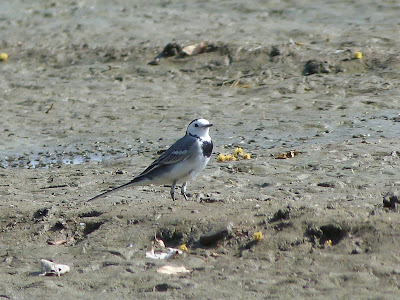
White Wagtail ...


The Greater Flamingo movement has been erratic again this year. A flock did appear but did not stay long. Only these two juveniles were left behind ...


Do have a look at earlier Posts about Chandloi - Winter Sundays at Chandloi ( Jan 2010) and Rare ducks seen at Chandloi ( Jan 2011)....

Any feedback is always welcome at sahdevsingh2004@yahoo.co.in


Friday, November 12, 2010

Rambles around Amer


It is the pre-dawn hour in early September 2010 and I am headed out towards the Amer hills north of Jaipur. This year the Monsoon has gathered pace in August and is forecast to continue bringing rain through much of this month. As I drive past the Amer Fort I am stunned by the spectacle of low rolling clouds obscuring the higher ramparts of this magnificent structure. Through the open windows faint tendrils of moisture laden mist waft past my face. The first bird sounds of the morning appear curiously muffled.

I am meeting up with Udaijit at his Dera Amer, and he has also invited Madhav, who is a keen Naturalist. I have not met Madhav , even though we have both visited here before separately. Soon I have turned onto the rough track that winds its way to the Camp. The light is already stronger and bird activity is picking up. Udaijit has often seen a Dusky Eagle Owl on its favourite perch just off the track, and even though I remember to scan all these likely roosts and perches today, I have yet to add this species to my personal list.

We meet at the Camp and introductions are made over a cup of Masala Chai. We are sitting by the Elephant Polo grounds and I pick out the movement of a small bird beyond the main Gate on a Babool tree. It is whistling a dulcet sounding half-familiar call. Quickly I check it with the binoculars. The bright yellow, black and white plumage and size could only mean one of the Ioras. We walk across briskly, Madhav is armed with a sophisticated lens on his Canon. But the Iora is hidden from view in the fresh greenery. At that moment an adult Oriental Honey Buzzard flies closer low to the ground, and we notice another much smaller juvenile. Now the Ioras shows themselves, it is a pair, and they are gathering nest material. From the white edges to tail feathers we know these are the Marshall’s Iora, a rare endemic. What a great start to the day !

My companions are enthusiastic and we feed off each others energy. Udaijit is still recovering from a horrific road accident and I think this is one of his first outings since. Despite our protestations to allow one of us take the wheel, he insists on driving his Jeep. Just outside the property we notice a large Cuckoo perched on the low wire fencing. Madhav gets some good photos and only later are we able to identify it properly as a juvenile Eurasian Cuckoo. There are a pair of Long-tailed Shrikes close by, and I do know that this species is often the foster parents of the Cuckoo.

Within a few minutes we enter the Nahargarh Bio-diversity Forest, as I believe it is now called. We have been here before, but none of us can believe the transformation brought about by the copious rains. Where there were sun-scorched acacias and other hardy dry deciduous trees with their gnarled trunks and sparse thorny foliage, now the fresh branches thrust upwards clothed in sparkling green. Dusty boulders are now hidden by lush wavy grasses, many topped with small yellow flowers on stems. Several bushes have these incredibly beautiful flowers, the scarlet and yellow petals curling upwards like twisting flames, and the horizontal stamens shooting outwards like the points of a star. We later identify these as Gloriosa superba or Glory Lily, and apparently they are deadly poisonous. I’m glad we didn’t pluck any since even handling the flower can cause severe skin irritation I later read.

Just inside the forest, as the path twists past a saddle between two hills there is a dumping ground for bones from the Animal Rescue Centre. From previous visits I know this is a good birding spot if you can stand the smell. We do see several Pied Cuckoos, Blue-cheeked Bee-eaters and European Rollers amongst other common birds. My best sighting here has been that of a Red-tailed Wheatear in April 2009. In the distance one can occasionally hear the Centre’s Tigers and Lions (rescued from the Circus after legislation banned animal performances). There is also a Tigon, he is huge with paws as big as dinner plates. And the bones at this dump are not from animals at the Centre dying of old age, they are from the leftover meals brought daily for the big cats !


As we wind our way deeper into the forest we come across several natural springs, the fresh water bubbling forth from cracks between lichen-covered rocks. This once common sight in the hills had all but disappeared for the past few near-drought years. As we climb a steep hill an unfamiliar looking raptor is disturbed and it flies off to a perch further away. We are careful not to get out of the Jeep and it allows us to approach closer. It is a Buzzard for sure, but all of us think it is somewhat large for a White-eyed Buzzard (which we have all seen before). Later checking of the photos, the dark gular stripe on whitish throat and the diagnostic white eyes confirm the sighting as the WEB. Another good bird is identified as the Black-headed Cuckoo-Shrike. It is quite shy and just does not allow one to get inside its comfort zone for close observation.

After a couple of wrong turns we finally find the right approach track to Aodhi Ram Sagar. Here a series of seasonal rivulets debouch down from the surrounding Amer and Nahargarh hills into small lakes leading towards this superbly located Shooting Lodge. There are also two old Shooting Towers made for the Jaipur Royalty. These command a wide field of fire, now of course the views are fabulous. I can almost picture in my mind’s eye how the game would have been driven down by beaters to the waiting guns. The main Lodge overlooks a small lake. Perhaps Royal Ladies would have had occasion to shoot downwards (from the relative safety of the high turret) at a Tiger or a Leopard drinking water in the late evening many decades ago ? While the gentlemen would have hunted on elephant back further afield armed with heavy bore rifles?

We have seen excellent birds here including the rare endemic White-naped Tit, White-capped Buntings and Paradise Flycatchers. This is also a good area for several raptors. Tawny Eagles apparently breed in the crags above. We have observed Steppe Eagles (5 individuals together once). Long-legged Buzzards are occasionally seen. Last year there was a juvenile Eurasian Griffon that was severely dehydrated and had to be rescued, cared for and later released in the wild. I have also seen Common Kestrel, and once the absolutely fantastic Eurasian Hobby. Surprisingly this was at about 11 am, unusual for the Hobby because they are largely crepescular. This little Falcon gave us a spectacular flight display of high speed stoops, driven with quick wing beats and diving with his long narrow wings folded back and sudden jinking turns.

We have now been rambling for hours and my stomach is rumbling. So when Udaijit suggests we head back to the Camp for breakfast, we concur quickly. Particularly since from previous visits I know that meals at the Camp are always splendid. Soon we are tucking into platters piled with two-eggs sunny-side-up, crispy bacon rashers, juicy sausages, baked beans and oven-fresh bread. All washed down with freshly brewed coffee. Ah ! This is the kind of birding I like.

Madhav shows us some of the photos he has taken today, and many are stunning. The light too has been friendly and many of the compositions are worth framing I am sure.

Udaijit tells us of the extraordinary incident involving 4 Bar-headed Geese making a surprise touchdown in the middle of the floodlit Elephant Polo ground on a winter’s night. Luckily this was between Chukkers (else they would have been trampled by the eles)! He describes them as appearing somewhat disoriented but not unduly alarmed. This was the night of 21st January 2009 and inevitably there was fog and clouds in the sky. Obviously the birds got confused in the fog and decided to come down and have a closer look at this pool of light in the middle of the forest. I have read of birds getting disoriented in similar conditions and crashing into lighthouses on the shoreline, but I do not know of a similar case as this. Yes, the story ends well, and the Geese team soon flew away unharmed.

Just as we must fly away today from this cracker of a weekend outing, till we meet again with tales of other trips …

Tuesday, March 16, 2010

Smriti Van Redux


Smriti Van, Jaipur.

Location of my 'serious birding', and setting for many memorable moments which are etched indelibly in my memory. Described by my father during a short visit many months ago as a 'birding paradise'.


" And there were gardens bright with sinuous rills,
Where blossomed many an incense-bearing tree;
And here were forests ancient as the hills,
Enfolding sunny spots of greenery. "


Okay, Smriti Van being equated with Kubla Khan's Xanadu may be stretching the poetic metaphor a little too far, but I'm sure you get my drift. A little over 15 months ago there were indeed 'sinuous rills' running with water; and today sweet-smelling shrubs and flowering trees still abound; extensive natural forests cover the valleys and hills; and busy sprinklers and irrigation pipes help keep the vegetation verdant.


Smriti Van is not old. It was opened to the public in the middle of 2008. I happened to be one of the early lucky few to visit, and since the Park's delights had not yet unfolded to the hordes, I often found myself wandering about alone for hours. 'Van' is an appropriate description for this place. Much effort has gone into amalgamating the natural forests, stony hills, and dry scrubby undulations with the 'introduced' shrubs, creepers, trees and plantations. There is also a fairly large waterbody with reedy banks providing sufficient cover to many waders and ducks. All of these natural features provide for a wide bio-diversity and different habitats for birds.


Smriti Van allowed me to spend many hours in the field getting myself up to speed as a birder. Not that I am any kind of expert today, but lessons learned here have helped make me a patient observer, and taught me the virtue of trying to learn something new (even about familiar birds) and keeping careful notes.


I have always had an interest in birds since I was kid. For instance, I was happy enough to ID a brilliantly-plumaged pheasant as a monal, on a school trek to Roop Kund (Uttaranchal), yet remained clueless about the 'partridge-sized, all-white birds' shooting downhill from a snow-covered slope, at a higher elevation on the same trip. Or, years later smugly pretending to know the 'fishing eagle' swooping down to grab a 'spurfowl' on the banks of the Cauvery river on a fishing expedition. Thinking back, for me the trigger to get the bird ID's correct was probably a few years ago on a family trip to Shoja (Himachal). I had gamely maintained a list of all the birds we saw on the trip. But there were so many that we couldn't ID, and some that we got egregiously wrong, the latter illustrated vividly by a common bird that I insisted on calling a 'blackbird' which was pointed out by a birder later on in the trip as a Blue Whistling Thrush !

Then H presented me one of the new bird guides. Having only referred to Salim Ali's books and the Collins Handguide over so many years, now the new names for familiar birds and all of this scientific jargon was a bit of a shock. Indeed the venerable doctor and savant of birding in India - Salim Ali, had once stayed with my parents in Bhutan, and even though I was unable to meet him being away at boarding school, I thought having his autographed books to refer to was the last word in birding.

And so we inch closer to the present, trying to get to grips with ID terms like 'supercilium'. Here is my first visit to Smriti Van dutifully noted in the birding diary for October 2008. Almost immediately I am among wonderful birds, some with whom I would be renewing acquaintance after many years, and others I would be observing for the first time. The next few weekends and early mornings (as the weather gets crisp and invigorating), I start to comb the hillsides, valleys and twisting tree-canopied walkways, with an absolute profusion of birdlife to identfy, study and enjoy.

Soon we are hoping to spot the rare White-bellied Minivet after already getting sated with common views of the colourful Small Minivets. Or hoping that one of the Black-rumped Flamebacks actually has a white 'v' on his back and so could be the White-naped Woodpecker. Or else, that one of the Great Tits hanging upside down to feed on a difficult to reach morsel, could be the White-naped Tit. Inevitably, I get started on my Jaipur Checklist. This soon starts to fill with the names of some impressive species. Since I am not a photographer, my observations are often questioned by fellow birders. And that is natural.

It is those special days when almost everywhere you look you see new and interesting birds that makes it all worthwhile. One such day last year threw up not one, but three new birds (for me) at Smriti Van. I was staking out the old 'Birding Point' - here a natural amphitheater is formed by steep slopes on three sides overlooking a natural hollow through which a narrow brook flows draining water from the lake. Overhead tall trees form an almost unbroken canopy. Bushes and reeds choke the ground. This was one of my favourite spots here. Just days earlier I had succeeded in being able to tell the difference between two of the common Pipits seen in the Park. The Tree Pipits found at this spot, often in pairs, darker streaked and walking along the grass and scrub covered slopes - as compared to the Tawny Pipit occasionally seen in the dry, open areas.

In fact, I was observing the Tree Pipits again when a 'hawk' glided in low overhead and perched on a branch overlooking the water. A solitary Common Sandpiper piped in alarm and dashed away. Almost at once, in overhead flight and at perch, I was quite sure this was not the common Shikra. In flight the underparts were strongly barred. As I struggled to train my binoculars on it the raptor dropped down to the shallow water. I was able to observe it for several moments. The Eurasian Sparrowhawk. Certainly a rare winter visitor for Jaipur. In my mind's eye I can still see the regal composure and stance of this little raptor.

As the raptor flew off normal activity resumed. A pair of Grey-headed canary flycatchers recommenced their twittering aerial flycatching routine. Prinias flicked their tails and flitted from one bush to another. Other common warblers went about their business. As I looked closely at a Whitethroat, I became aware of another warbler that looked quite different in this group. This individual had a markedly dark (almost black) head and was larger than the Whitethroat. Another new bird for me - the Orphean Warbler.

Just as I finished updating my notes for the hawk and the warbler a wonderful new bird flew across and perched on a tree on the slope. Thrush, I mouthed silently to myself. But which one ? The bird was calling softly, drawing attention to its yellow bill. It was almost uniformly grey all over, darker above and paler below with yellowish legs. The Tickell's Thrush. Oh the clean, sleek lines and delicate demeanour !

Later that day as I was recounting the experiences to a fellow birder, he enquired of my progress with the Jaipur Checklist. We glanced through the list and many names just jumped out at me. Sirkeer Malkoha. Common Iora. Bluethroat. Black-headed Cuckoo-Shrike. Black-winged Cuckoo-Shrike. Common Rosefinch. Barred Button-Quail. Grey-necked Bunting. Oriental Skylark. Now, as I write this blog in March 2010, I am reminded that for many of these birds I only have record of an occasional further sighting at other locations near Jaipur.

Common Rosefinches I have only seen on passage twice in two years - once in Spring and once in Autumn. On both occasions I can clearly recall that their bright pink plumage stood out in stark relief on perch against the ground and trees.

The Barred Button-Quail - both solitary individuals- were encountered on the stony hillside in Smriti Van. On one occasion I surprised one individual which suddenly found itself stranded in the open between the only available cover of rocks and bushes. I must admit its reflexes were quicker (damn the 'licker' !) and as I stood frozen, it was off in a flash.

The Bluethroat, in my opinion, is not a common visitor to Jaipur. I had seen a male at Smriti Van in the winter of 2008, close to the two water tanks in the open scrub and bushes near the expansive lawns. Having drawn a blank on this species lately - at several other likely sites, I was pleasantly surprised to see a pair this time at the exact same spot. The male (other than chasing the female at high speeds low over the ground dodging past bushes) , was an accomplished scurrier, scooting forward several paces on quick feet then cocking the tail and pecking at the ground.

The Common Iora again I have encountered only a few times in Jaipur. The first occasion was on a eucalyptus tree in Smriti Van and it was sporting a fairly drab non-breeding plumage. Only later when I observed several birds in Udaipur, did they have the more colourful yellow and black plumage, and were giving vent to their wide spectrum of calls and whistles.

I'll end this post by trying to describe a curious behaviour that I observed over several occasions at the main tank in the Park. At that time this tank held several inches of water. A Shikra was observed on three occasions waddling into the slightly deeper water. When the water level was up to its thighs it would stop and stand for minutes at a time. Occasionally ducking its head into the water, but being careful to not get its tail wet. There were some fish being reared in this tank, but I am quite sure it would not have caught one even if one swam through its legs. Could it just be cooling off ? (this was winter remember) or was it getting philosophical ??...

To misquote Ralph Waldo Emerson -

" All birds are poets at heart. They serve nature for bread, but her loveliness overcomes them sometimes."

But, why Smriti Van Redux ?

Because it was once a birding paradise. Then man arrived and the garden was spoilt. Now we are hoping that the good old birding times will return. Believe me, one good monsoon and we are back, as they say in Rajasthan!


Sunday, January 17, 2010

Winter Sundays at Chandloi


Local newspapers in Jaipur have been reporting for several years the increasing numbers of waterfowl and other birds observed at Chandloi lake. Finally, interested enough by photos of Greater Flamingos, I made my first visit in the middle of September 2009.

Owing to the paucity of rainfall around Jaipur this monsoon season, I was quite surprised by the spread of water in the lake. The lake is surrounded by much habitation and agricultural fields. In the middle small islands covered by kikar trees clearly are magnets for a large number of waders and ducks.

A motley group of people was already gathered on the embankment and seemed to have eyes only for the star attraction – the Flamingos. Indeed, 1000+ Greater Flamingos were bunched together in a tight flock, swimming in the deeper water and then wading up to the islands in the middle. A pair of Painted Storks had built a nest on top of a kikar tree, as had several Cormorants. I followed the progress of their nesting over the next few weeks. The Stork nests were soon abandoned, but the Cormorants were successful in breeding.

As with any North / Western Indian jheel in autumn (and later through winter), the air, water and land was literally teeming with life. Overhead, twittering Martins and Swallows swooped low over the water and wheeled higher in the sky. The margin of the lake had the usual assortment of waders – Sandpipers, Stints and Plovers, chasing each other off their separate pieces of turf. Rosy starlings flew past in large numbers, rising from adjacent agricultural fields, adults showing much pink, but the juveniles plain brown.

However, for me the highlight that first day was a migrating group of Grey Wagtails that literally swarmed the area in their hundreds. H later told me they were possibly on passage, since we did not see them in such numbers again.
Interestingly, during a subsequent visit on 10th January 10th 2010, S and I saw a much smaller flock of Yellow Wagtails exhibiting much the same behaviour. The Yellow Wagtails varied in the extent of yellow on the underbody – some juveniles (?) with much duller plumage.

Another curious observation is that in September we saw a small flight each of the Black Ibis and the Black-headed Ibis, but not another Ibis over 10 subsequent visits through January.

In sifting though my notes I also notice that the composition of ducks commonly seen kept changing over the months. In September our resident ducks like the Spot-billed Duck, Lesser Whistling Duck, Comb Duck and Cotton-pygmy Goose were joined here by the first of the winter visitors - the Shovellers. Over the next few weeks it was almost as if the residents kept getting pushed out by migrants. In October we observed good numbers of Gadwalls and Pochards – both Common and Tufted. We have record of Common Teals and Ruddy Shelduck in November. Bar-headed Geese (200+) arrived in December, and apparently have good feed on the islands which were now exposed as the water receded. The handsome Northern Pintails (100+) also appeared in December. And then just after Christmas a pair of Greylag Geese, unmistakable with their large size and pink bills and legs, and quite careful not to be seen consorting with their bar-headed cousins.

Another pattern developed over subsequent visits to Chandloi – from visits spanning a few hours, I often started spending the whole day Sunday around the lake. Sometimes alone, and on some occasions accompanied by relatives, friends and expert Birders (each group not mutually exclusive). Every visit was a learning experience. One always observed something new. Conditions kept changing. As we ranged farther afield around the lake, we discovered our little ‘hot spots’.

One in particular keeps throwing up new surprises.

The Eastern embankment draws a finger of the lake deeper towards the Railway tracks. This narrow water body is a good area to observe birds at close range both in the water and in the ‘thorny vegetation’ covered banks. The ‘thorny vegetation’ is actually an infestation of Angrezi Babool (Prosopis juliflora). If only we could somehow replace this with ‘proper’ trees and shrubs, the bird count would explode. Thankfully, the embankment is also studded with several kair and ber bushes. Agricultural fields also provide feed and cover to several birds.

Often we have strolled along the embankment, the lake on the left and the agricultural fields to the right. Once an unfamiliar and vocal flock of birds with bright yellow underparts, was identified with some difficulty as Black-headed Buntings. The same day we saw another new bird for me – the Black-headed Munia. This was the Atricapilla sub-species with all-chestnut belly and flanks. A pair of Scaly-breasted Munias provided entertainment chasing each other between the kair bushes. Brown shrikes also have their favourite perches here – and we have seen both sub-species - Cristatus with brown crown and Lucionensis with grey crown.

This area also seems to be a favourite haunt of several raptors. On one occasion we observed 6 Eurasian Marsh Harriers in flight. The same day a pair of Booted Eagles quartered the sky just above. On 20th October 2009 I recorded a pair of Ospreys. Later through December one Osprey stayed back. At first, this bird looked rather bedraggled, and perched forlornly for hours on a stone post in the middle of the lake, and we thought it may not survive for lack of prey. But just days later we saw it again, feeding on a fish, and then taking to the air with renewed vigour.

Closer to the Railway track and in the dry, scrubland and fallow fields in winter, apart from the common birds there are also the Tawny Pipit, Greater short-toed Lark, Red-collared Doves, Pied Bushchats, Siberian/ Common Stonechats, the occasional Desert Wheatear, and a party of Common Quail.

One bird which I have seen on every occasion through this winter has been a very large Gull. Amongst the usual assortment of Terns and smaller Gulls, this individual was distinctive for its size. Finally, we were able to ID this as the Pallas’ Gull – a non-breeding adult. It often feeds on dead fish washed up on the islands, even chasing away the larger Grey Herons that flap too close to its meal.

This post would be incomplete without a mention of another special bird that only arrived a few weeks ago at the lake.

DB and I had observed two separate flocks of very large birds flying North as we approached Chandloi from Jhalana Reserved Forest on 27th December 2009. We enjoyed excellent views as the Great White Pelicans wheeled in tight circles low over us. However, the Pelicans did not come down to the lake that day. Then on 10th January 2010 accompanied by S, we had seen a solitary Pelican sitting on a small island newly emerged in the lake. Earlier that day I had added the White-tailed Lapwing to my personal checklist. As the day drew to a close S pointed out a flight of Pelicans approaching the lake. Quickly we scrambled closer hoping to see them touch down. The Pelicans banked and dropped lower. While one bird nonchalantly scratched its belly with a webbed foot, another kept twisting its neck as if to see if the flight formation was being maintained. Soon they settled down gracefully on the surface of the water close to their mate on the island.

Getting to Chandloi lake from Jaipur –On the Jaipur – Kota highway, and past the Jaipur (Sanganer) Airport. Another 15 kms away you arrive at the village of Shivdaspura. From here you turn right towards the village of Chandloi, 2 kms away. My usual routine on morning visits is to park at the Petrol Station short of Chandloi village. Just across the road from here is an earthen embankment encircling the lake. Having the sun behind you is useful as you gaze across the water.


Happy Birdwatching !

Thursday, January 7, 2010

Day of the Cuckoos


Here is a recap of an afternoon trip made on 25th July 2009 when we came across 4 species of Cuckoos near Jaipur. While some of you may well spot several more Cuckoos in a day's birding if you explore more suitable terrain in different parts of India, but for us semi-desert dwellers of Jaipur , a day like this is special because some of these Cuckoos are rare summer / monsoon visitors.

S had piqued my interest about a new location where he said we had every chance to come across two species of birds high on my 'to do' list at that time - the White-naped Woodpecker and the White-naped tit (....as it would happen we saw neither that day).

So on Saturday afternoon N and I took the Jaipur-Chomu highway. We branched off at Chomu towards Samode and soon found our 'hot-spot'. This is where the road first cuts across a section of the Aravallis. On either side the hills tower overhead. A narrow glade runs along the base of the hills. Abutting the slope is a shallow ravine which drains the rainwater from the hills. It is a scenic and desolate spot, which we were later to discover was the reason it is not the safest (but that's another story).

A Common Hawk-Cuckoo ( Hierococcyx fugax) was calling close by, the tone rising in pitch steadily. We quickly had our gear organised and set off on foot. I have often found it difficult to actually sight this bird even standing right under the tree where the calls emanate from. This occasion was no different. Within a few minutes the bird flew off to another copse across the road.

The monsoon had broken a few days ago and there was fresh grass carpeting the glade. This had attracted several butterflies - some tiny ones like Blues, and others like Plain Tigers, Danaid Eggflies and Common Emigrants. A brilliantly coloured Blue Pansy favoured the damp ditch.

Soon our attention was attracted by an unfamiliar call from the hillside. We moved closer carefully, but the calls ceased immediately. We scanned the boulder-strewn hill which rose steeply, dotted with some acacias and several bushes. A faint movement behind a kair bush (Capparis decidua) enabled us to train our binoculars on a skulking bird. It was grey (darker grey upperparts), with a fleck of white on the wing , and white tips to tail feathers. The relatively smaller size and a quick reference to the guidebook confirmed the male of the Grey-bellied Cuckoo ( Cacomantis passerinus). The bird was quite wary and kept moving to deeper cover all the time.
Meanwhile, the glade was full of bird activity triggered perhaps by the profusion of insects and plants given life by the recent rains.
Prinias were plentiful. The grey-breasted prinias were now displaying their breeding colours which indicate their name. Plum-headed parakeets streaked overhead calling excitedly. Indian Silverbills swarmed the ground and low perches. There was a mixed group of Great Tits, Common Woodshrikes and Small Minivets. Other birds which I have found difficult to see in the non-winter months in Jaipur like the Pied Bushchat and Oriental White-eyes flitted about. Refreshingly, we saw White-eared Bulbuls rather than their ubiquitous (urban) red-vented cousins.
We had recently observed one of my favourite summer visitors - the Indian Pitta, but it was not here today. Golden Orioles stood out as bright patches of colour in the brown ( now burgeoning green) foliage.
We decided to follow a narrow goat-track winding upwards. I had passed by a small dark bird without so much as a second glance thinking the song was that of a Indian Robin, when N called me back with much gesticulation, and we actually had a beautiful male Crested Bunting in full song. Females dotted the steep grass-covered hill close by.
We could hear a noisy rabble of birds ahead as the track turned. Soon we were looking down at a breeding colony of Baya Weavers. The males were now sporting bright yellow caps and chests. The excitement was palpable and several males had already part- constructed their nests, suspended from the ends of branches of kikar trees.
As we climbed higher, we heard the familiar calls of the Pied Cuckoo (Clamator jacobinus)overhead. A pair flew across the crest of the hill allowing us good views.
This year we had been observing the Pied Cuckoo since the middle of June at several locations, but every new sighting was a delight.
Soon we were clambering up a saddle-back. The hill rose higher to our left with the path zig-zagging up to a temple. To the right the land fell away in a series of ravines - not unlike the badlands of the Chambal.
It was here that we saw our fourth Cuckoo of the day. Or rather a pair of them. These Cuckoos were much larger than the Grey-bellied. Even though we could not get very close, the defintive ID was made by the call. The Eurasian Cuckoo ( Cuculus canorus). Again, we had observed this bird at another location a few weeks before, and had heard them calling at other places. But never 4 different Cuckoos at the same location. Does the Asian Koel qualify as a Cuckoo, I wonder. Because that was around too, as everywhere else.
By now the day was getting on and we decided to turn back.
As soon as we descended to the grassy glade I almost stepped on and flushed a covey of Quails who exploded away with a whirrrr of rapid wingbeats. Startled, I was concentrating on putting down my next footstep when N called and pointed to a brightly colored bird perched on a Ber bush ( Ziziphus mauritiana). It had bright rufous upperparts, and was quite enjoying its meal of a hairy caterpillar. On the same bush was also a tiny Ashy Prinia. For a moment we were puzzled, then the call gave it away. It was a hepatic female of the Grey-bellied Cuckoo. The male called in reply from the general direction we had seen it earlier today.
Perhaps some reader could let me know if the Grey-bellied Cuckoo breeds around Jaipur at this time of the year. The Ashy Prinia sure looked like a prime candidate for a foster parent.

Well that's it for this post... in the next few I hope to give you a flavour of some of the other Jaipur birding locations (like Chandloi lake, Jhalana Reserved Forest, Nahargarh Reserve Forest and Jal Mahal and others) and some of the other 'special' birds that we have been seeing there.